When to Split an AI Agent: Subagents vs Swarms
More agents is not automatically better. A November 2026 study found swarms finish faster but score worse on the same token budget, and a single agent with a fresh context catches up. Here's when to use a subagent, when a swarm is worth it, and when to just reset.
You have seen the headlines: a thousand agents formalising a proof, a swarm rewriting a codebase, a vendor post telling you to "just use subagents." So here is the practical question most of us actually have. When is my agent overloaded, and when does splitting the work help rather than just spend more tokens?
If you want the background first, I walked through the loop, tools, memory and planning of an agent in Anatomy of AI Agents: How They Actually Work. The system around the model — context, checks, stop rules — is what I called the harness in What Is Harness Engineering? The Part of an AI Agent That Isn't the Model. This post is about one design choice inside that harness: how many agents should share the work.
Let's take this step by step.
What is the difference between a subagent and a swarm?
People use these words loosely, so it helps to separate three designs.
| Design | What it is | What it is for |
|---|---|---|
| One agent, one session | A single loop that keeps everything in one context window | Simple or tightly connected work, where earlier steps still matter |
| One agent, fresh context | The same agent, but you start a new session (or reset the window) when the context gets stale | Long tasks where the model has started to forget early instructions or drown in tool output |
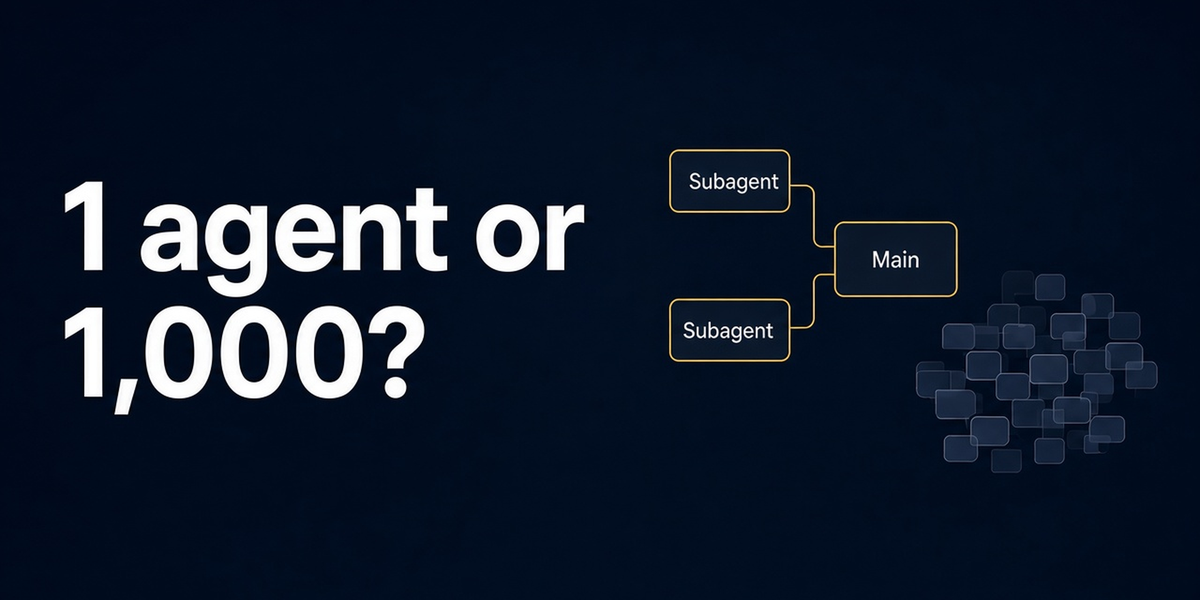
| Subagents | A main agent hands a scoped task to a child agent, usually in a fresh context, and gets back only the result | Isolating messy work, or getting a second look that is not biased by the first agent's trail |
| Swarm | Many agents work on the same goal at once, often coordinating as they go | Finishing faster when wall-clock time matters more than token efficiency |
A subagent is not "a tiny swarm." LangChain's docs describe the default pattern clearly: the child runs with a fresh context, sees the task you gave it, and returns a final report. The parent never has to hold the dozens of tool calls that produced that report. That is context isolation, not a bid for more intelligence.
A swarm is a different bet. You are paying coordination cost — planning, messages, stepped-on work — in exchange for speed.
What did the swarms study actually find?
Niccolò Zanichelli and Gavin Leech at Paradigm3 published "Swarms do not yet raise the roof" on 24 November 2026. They compared teams of 2, 4 and 8 agents with a single agent given the same total token budget, across four long-horizon tasks and three ways of organising a team. They ran over 1,100 runs and more than 80 team configurations.
The headline result is easy to remember:
- Swarms were much faster. In their experiments, about 6 times faster.
- Quality went the other way. Teams took about a 7% penalty relative to a single agent.
- The penalty appeared to grow with team size. On one task they also tried teams of 16 and 32, and those did no better than teams of 8.
At an 8 million token budget, they found no quality gain from swarms on unsaturated tasks. When they raised a near-miss task to 32 million tokens, a self-organised team of 8 did beat the single agent. Then they let the single agent restart with a fresh context, and the single agent won again.
Their reading of earlier "swarm premium" results is that the single agent had gone stale. The extra agents were helping mainly by giving the work a clean window, not by being a crowd.
This is one group's experimental setup, with a limited budget, and the authors are careful about that. Teamwork training is still early. They also make a fair practical point: getting about 93% of the result in a day instead of a week can be the right trade, especially when time is the scarce resource — a security incident, a market move, a deadline. That is a speed decision, not proof that more agents are a new scaling axis for quality.
When should you use a subagent?
Use a subagent when the problem is the context, not the clock.
LangChain also describes a "forked" subagent, which inherits the parent's conversation instead of starting blank. That is useful when the child must continue work the parent has already diagnosed, so it does not have to rediscover the same files. The trade-off is less isolation and a bigger prompt. Use a fork to continue; use isolation to inspect or to keep the parent clean.
Skip the subagent for a simple, one-step task. The overhead of briefing a child and stitching the result back is not free, and a small job does not clutter the window.
When is a swarm actually worth it?
Ask whether you are buying time.
A swarm can be the right call when:
- The deadline is real, and a slightly weaker result today is more valuable than a slightly better result next week.
- The work can be split into pieces that do not constantly block each other.
- You can check each piece, so a bad child cannot silently poison the whole run.
If those are not true, you are probably paying a coordination tax for a worse answer. "1,000 agents" is a memorable headline. It is not a design principle.
A cheaper first experiment, before you stand up a swarm, is the one the Paradigm3 result points to: reset the context. Summarise the state, start a new session, and continue. If quality jumps, your problem was a stale window, not a missing workforce.
A three-question heuristic
Before you split an agent, ask:
- Is the parent overloaded, or just slow? If the context is full of tool output, or early instructions are being ignored, isolate or reset. If the model is simply taking wall-clock time on a well-scoped task, more agents may not help the answer.
- Can a child return something I can check? A test result, a diff, a list with sources, a yes/no against a rubric. If you cannot verify the sub-result, you have multiplied uncertainty, not divided the work.
- Am I splitting for context or for speed? Context: use a subagent (or a fresh session). Speed: a swarm may be worth a quality and token cost. Quality alone: keep one agent, and give it a clean window when it needs one.
If you want to measure this on your own workload, keep the comparison fair. Fix the task and the total token budget, then run three conditions: one session, one agent with planned context resets, and a parent with a few subagents. Compare quality, time and cost. Do not declare a winner from a single unbudgeted demo.
What are the trade-offs?
- Coordination costs tokens. Someone has to brief the children, merge the results, and recover when two agents edit the same thing. That work comes out of the same budget.
- Isolation can waste work. A fresh child may re-read files the parent already fetched. A fork reduces that waste and reduces independence.
- Speed and quality are different scores. A swarm can be the correct engineering choice even when it loses on quality, if time is what you are buying.
- Verification is the limit. A thousand agents with no checker will produce a thousand claims. A smaller setup with a reliable check will usually teach you more.
Conclusion
The useful reframe is this: splitting an agent is a context-and-time decision, not a way to make the model smarter. Subagents earn their place when they protect the main window or give you an independent check. Swarms earn their place when you need the result sooner and can live with the cost. And quite often, the move that actually raises quality is the least fashionable one — start a fresh session.
References
- Swarms do not yet raise the roof — Niccolò Zanichelli and Gavin Leech, Paradigm3, 24 Nov 2026.
- Subagents — LangChain Docs (Deep Agents), accessed 26 Nov 2026.
- Organizing Context in a Multi-Agent Harness — Thushanth Bengre and Chester Curme, LangChain, 8 Sep 2026.
- Subagents (multi-agent) — LangChain Docs, accessed 26 Nov 2026.